Metal Max Recyclers
Why Do Construction Sites in Western Sydney Generate More Scrap Than Homes?
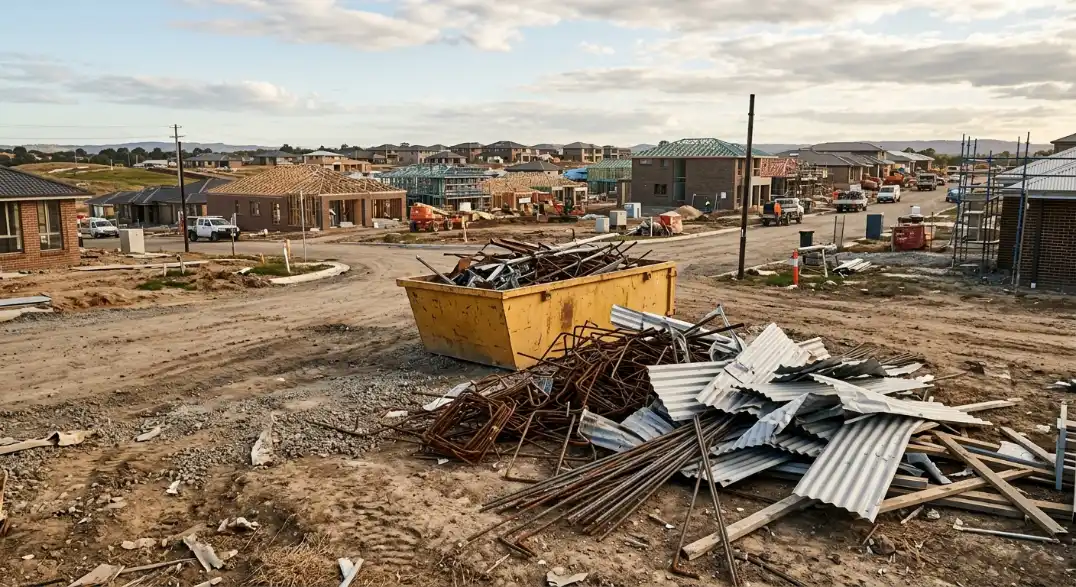
Look at nearly any block in Marsden Park, Box Hill or any of the recent new estates that are appearing throughout Western Sydney, and you’ll see the same thing at almost every home: a skip bin full of odds and ends, a few reo bar butts stacked up against the fence and a heap of unwanted roofing sheets resting on pallets. Consider, for example, the average household up and down the street, which may yield, let’s just say, a few bent nails and one segment of an old gutter every couple of years. Compare that to the average house a few blocks away that may, every few years, yield, say, a few bent nails and one waste section of an old gutter.
We’re in construction scrap collection right throughout Sydney, and this question is always coming up, whether it’s from site managers or from people deciding to do a renovation and are asking where all of this metal goes, or the people who drive past a construction site and say to themselves “where the heck does this stuff end up”. First, the answer is a resounding “ metal”, and second, it is used in metal, it is cut into metal, it’s trimmed into metal, replaced by metal, and thrown away in metal, and ordinary human life can’t compare. But the longer answer carries the importance of understanding it, particularly as you’re a site owner looking to make money out of a liability, rather than another liability.
A Full-Day Event to Help Site Managers and Their Colleagues Stay Up to Speed
A couple of months ago, we received a call from a site supervisor working on a medium-sized City of Rouse Hill development of townhouses. We took him on a tour with him, and when he told us the price for the garbage pickup, he had to shed tears, and it was no wonder. Along the edge, some bundles of steel reinforcement offcuts, other bundles of aluminum window frame trim, old structural steel that was structurally redesigned mid-build, and copper pipes which had been removed during a redo on a plumbing scheme. It wasn’t rubbish like it is when the family throws it in the trash. It was valuable scrap metal, which was just trash.
As soon as we separated a waste stream and properly collected it, the costs of waste disposal dropped drastically at the site, and some of it even provided financial benefits! The reaction of the supervisor that we remember was “I’ve been paying to throw away money for 2 years and didn’t know it!” It’s an all-too-familiar tale, and it’s for this reason that it’s important to know where construction scrap goes.
How Construction Sites Produce So Much Scrap Compared to Homes
A house is a “product” that is completed and not routinely rebuilt. A construction site, on the other hand, is one that is working on chopping materials to precise measurements; as a construction process, it will always result in off-cuts. Each build pushes the build pile.
- Structural framing and steel beams are cut to highly accurate lengths, and the leftover ends of beams are seldom used on location again.
- These offcuts are continually cut from reinforcement bar (reo) to match the specification of slabs and footings, resulting in bundles of short cut-offs.
- Sheets of roofing and cladding are cut around vents, edges and joints, resulting in irregular or abnormal scrapped parts.
- Conehead and electrical finish require the generation of copper piping, aluminum, and electrical offcuts during the construction of the conehead.
- Old fixtures, railings, and structural metal are removed during demolition and/or renovation.
- Changes in design can result in surplus of material, often right after the project has begun.
This level and diversity of production don’t happen in a household. The use of metal in fixed and finished applications like the home’s roof, fence, gutter and appliance keeps it in use for years or decades. Construction sites are always consuming metal as kitchens go through offcuts in the course of making meals, in huge portions.
I Was Surprised to Discover the Total Cost of Treating Scrap as Rubbish
This is where far too many builders lose money that they don’t even know about. When construction waste metal is thrown out with general trash in a general waste skip, it incurs general waste rates, and also any value found in the metal, aluminum, or copper will be lost totally. If separated properly, the same can be picked up, weighed, and then, many times, converted into a payment to the property rather than an expenditure.
We’ve seen this error most frequently on shorter schedules, when crews are working to keep up with their own schedules and don’t consider sorting any part of a top priority. Actually, this is understandable; it is also one of the most cost-effective expenses to have settled upon installation of an appropriate collection system.
The Efficiency of Scrap Metal Collection Sydney Sites
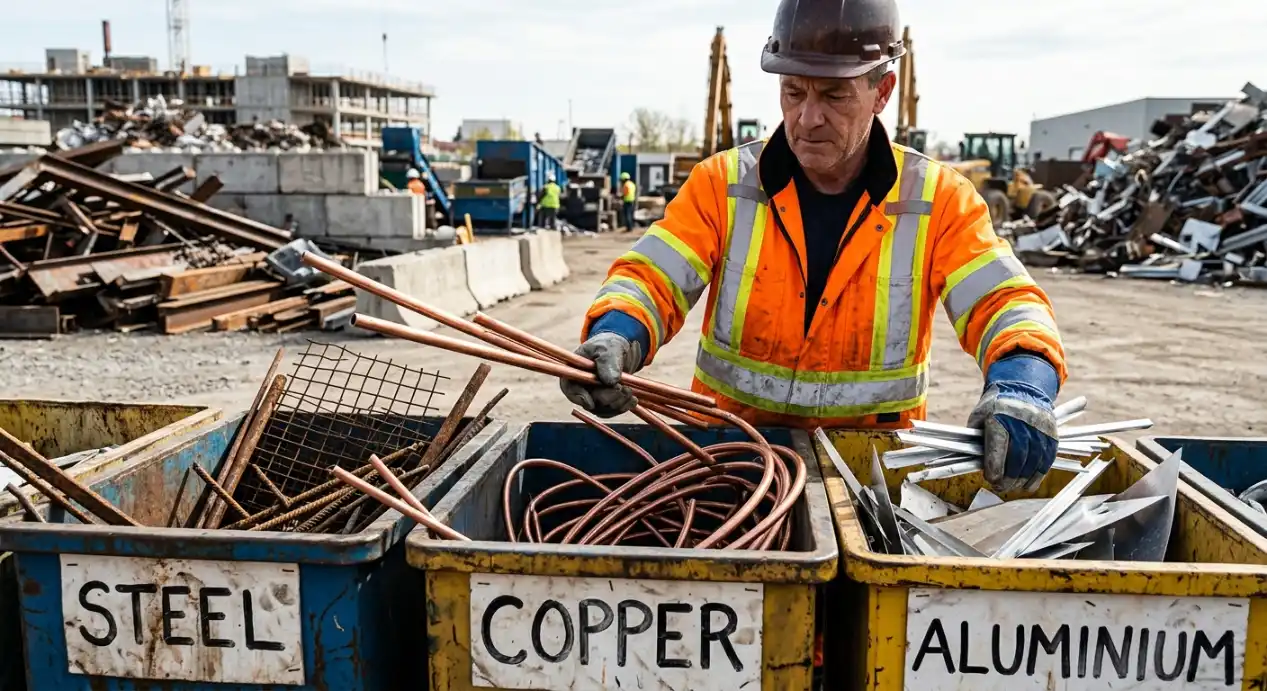
The efficiency used by scrap metal collection Sydney sites. An effective collection process doesn’t have to slow it down. We work at a number of sites in Sydney, and generally the frequency is quite predictable once they are established:
- On-site designated bins or cages for different metal types: steel, aluminum, copper, and mixed offcut steel/copper/iron/bronze/brass, etc.
- Regularly scheduled scrap metal pick-up or when bins are full (on request).
- Weighing and sorting onsite (applying value accounting for material).
- Documentation will be submitted for sites with a need for waste tracking for compliance and/or reporting purposes.
This is particularly important when working on a project where the whole site is being offcut when it is all ready versus early in the project when the noise is less. Websites already built with plans for recycling from the ground up will probably be less expensive to dispose of and get a greater return value throughout their lifespan. If your builds are spread across several addresses, our guide to scrap metal pickup for property managers covers how to keep collection consistent across every site.
Construction Waste Recycling: Not Only Is It Good Practice, But It’s Good Business!
It also has an environmental implication, and a pretty serious one! This avoids the need for newly mined and processed metal, one of the more ‘harder to obtain’ materials in the construction industry, for every tonne of steel or aluminum that is recycled, instead of being sent to landfill. However, for the builders and managers of sites, it is the business case that typically wins.
Good construction waste recycling should be less expensive because the general waste is not being removed unnecessarily, keeps the site cleaner and safer, and can even be paid for in a lot of instances for the metal that is recovered. With this being one of the more cost-effective sustainability measures, it is becoming increasingly part of the company’s consideration in the site planning process in western Sydney as an initial investment, and not as an add-on. It’s also worth checking how Sydney scrap metal regulations apply to your site before you settle on a collection partner.
If You Have a Website, Then This Is a Concern That Would Have to Be Addressed
If you are running a site, then this is an issue you need to resolve. If your site does create steel offcuts, aluminum trims, copper piping, structural scrap, etc regularly, then it may be better to think of them as an asset to your site and not as a disposal issue. People will typically find many more recoverables behind skip bins, by the fence, or in a congregation as the next general waste pickup; a quick walk around most active sites would return more metal than people would expect.
Book Your Site Collection
If your site in Western Sydney is generating more scrap than it’s dealing with efficiently, get in touch with our team for a straightforward scrap metal pickup and collection service built around active construction schedules. Curious what your load is worth first? Check today’s scrap metal prices.