Metal Max Recyclers
E-Waste Recycling Sydney: Why Circuit Boards Hold Metal
Published November 25, 2026 · METALMAX Recyclers
Walk into any office clear-out and you will find the same pile: dead desktops, tangled cables, an old router, and a server that has sat unused in a corner for years. It looks like rubbish, but inside it are copper, aluminium and small amounts of precious metals that can be recovered and reused. That is why e-waste recycling matters, both for the environment and for your bottom line.
The principle is simple. The metals in circuit boards, cables and casings can be separated and sent back to manufacturers as raw material. What your load is worth depends on what is in it, how clean it is and how well it has been sorted. Cables follow the same rule, and they are often the easiest part of a clear-out to recycle.
This guide explains what is inside old electronics, what affects their scrap value, and how to be paid fairly for them in Sydney. It is written by Metal Max Recyclers, based in St Marys in Sydney’s west.
Quick answer
- Circuit boards contain copper, gold-plated contacts and small amounts of silver, tin and palladium.
- Cables are copper or aluminium wire inside a plastic jacket.
- Sorting is the key. Mixed loads are harder to value and usually return less.
- Value depends on the type, quality and quantity of material, and on current market prices.
- Payment is by bank transfer (EFT), and you may be asked for ID.
Why circuit boards hold valuable metals
The green board inside a computer is mostly fibreglass and resin. The metal is what makes it worth recovering. Copper tracks run across the board and carry power and signals between components. Connectors and edge contacts are often plated with gold, because gold resists corrosion and keeps a reliable electrical connection. Solder is usually tin-based, and some components and connectors contain small amounts of silver or palladium.
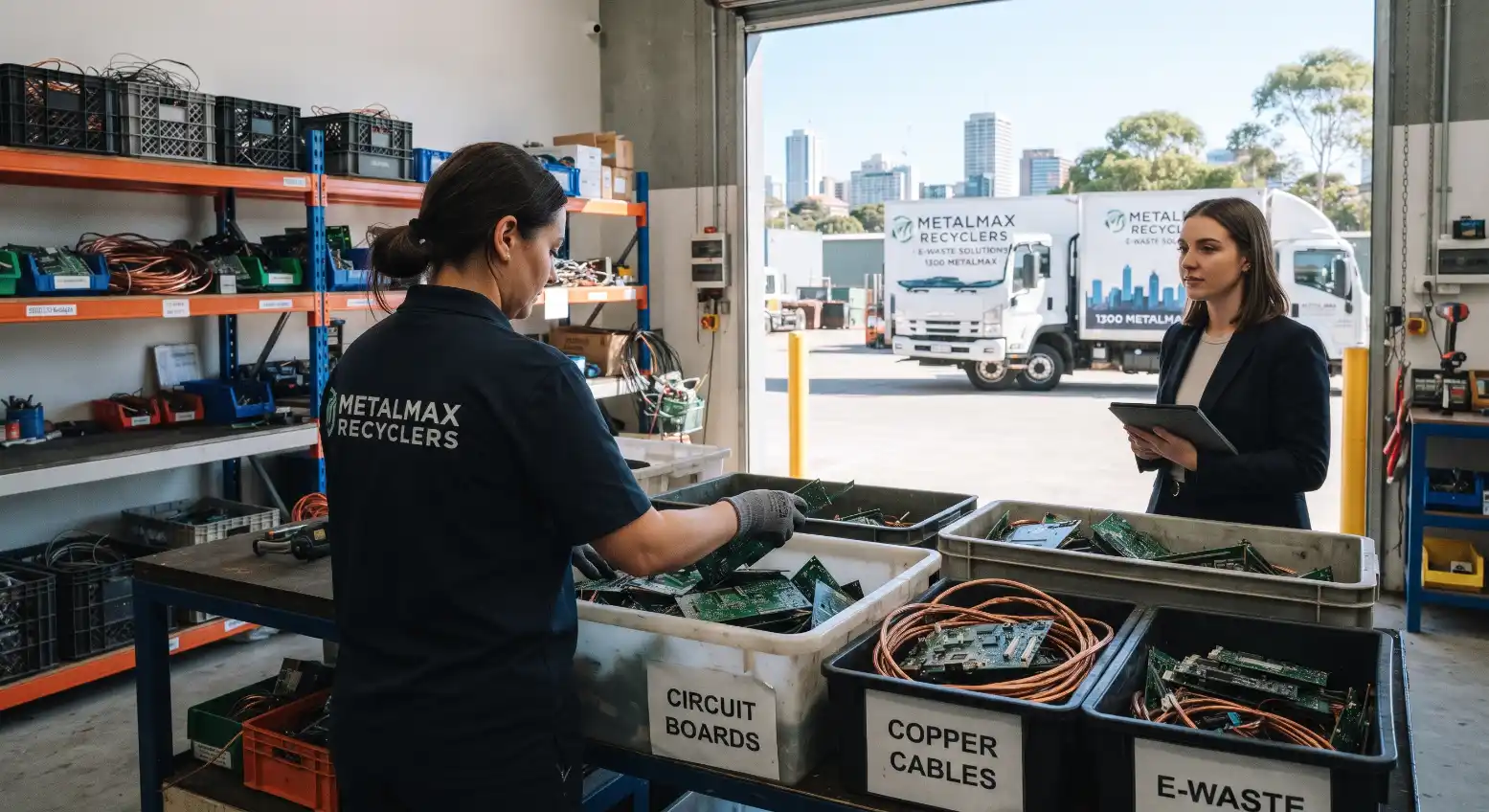
The amounts are small, but they add up across many boards, and manufacturers want these materials back when a device reaches the end of its life. Recovering them takes specialist processors rather than an ordinary scrap yard. We collect and sort your material and make sure it is passed on responsibly, which is the heart of good electronic waste recycling.
What a typical load of e-waste contains
- Laptop and desktop boards: Copper tracks and gold-plated contacts.
- Servers and network equipment: More boards, plus heat sinks and metal cases.
- Power supplies: Copper wiring in a steel or aluminium casing.
- Casings: Most are aluminium or steel. Deal with any data on the device before it goes.
- Small mixed boards: Phones, switches and other small electronics with a range of materials.
Why sorting scrap cable matters
Cable is a very common part of a clear-out, and it carries real value because of the copper inside. Once the copper can be identified, it is worth far more. If every cable ends up in one bag, nobody can tell what is in it, and the price drops. Good scrap cable recycling starts with sorting.
Sort cable by type
- Power cable and building wire: Copper conductors, usually the most valuable.
- Data cable: Cat5, Cat6 and coaxial.
- Aluminium cable: Keep it apart from copper.
- Leads with plugs attached: Chargers and USB cables are lower value because of their plastic plugs and thin wire.
Never burn the insulation off to expose the copper. The fumes are toxic and it is dangerous. If you have a large amount of clean copper, contact us to arrange copper recycling.
What affects e-waste scrap value
The value of a load comes down to what the metals are worth, how easy they are to recover and how much there is.
- Material: Copper cable and boards with gold-plated contacts usually return more than plastic casings and thin mixed leads.
- Sorting: Cables, boards and metal casings kept in separate containers are far easier to value than one mixed pile.
- Condition: Damaged boards and cables are worth less.
- Quantity: A larger load is generally more efficient to collect and process.
- Market prices: Metal prices move, so there is no fixed rate. See our prices page or send photos for a quote.
Preparing for e-waste collection in Sydney
Where your equipment is can matter as much as what it is.
- CBD buildings and loading docks: Book the dock, check the lift size and allow for time windows. Many buildings have their own access rules.
- Mixed loads: An office move or fit-out usually produces only a small share of e-waste. The rest is often steel racking, copper pipe and aluminium frames. Separating these makes it easier to get a fair price.
- Lease end dates: If you are short on time, call early. Collection times depend on location and the time of day.
- Skip bins versus metal collectors: A skip takes everything away and you pay for it. A metal collector may take the valuable material and cost less for metal and e-waste clear-outs, so compare your options.
We collect across greater Sydney. Our yard is at 172 Canberra Street, St Marys, and we are open Monday to Friday, 6 AM to 4 PM.
Common e-waste recycling mistakes to avoid
- Mixing everything together: Keep cables, boards and other material separate.
- Leaving batteries inside: Remove them if you can do so safely, and tell us about them. If a battery is swollen, hot, leaking or damaged, do not force it out. Keep it separate and tell us before collection. Lithium batteries in a mixed pile are a fire risk.
- Skipping the data backup: Copy what you need before you wipe a device for handover.
- Stripping boards by hand: It is slow, can be hazardous and is rarely worth the effort. Hand over whole devices instead.
- Accepting a quote without questions: Ask how the material is collected, how and when you will be paid, and where it goes afterwards.
- Misdescribing your load: Surprises at pickup lead to renegotiation.
How you get paid for e-waste
If your load has value, Metal Max Recyclers pays by bank transfer (EFT). Because e-waste contains metal, selling it for recycling can fall under NSW scrap metal law. That law sets rules about how dealers may pay, what records they must keep, and the ID you may be asked to show. Dealers cannot pay for scrap metal in cash. Check the current requirements on the NSW Police scrap metal industry page.
Separately from the law, our own practice is to pay by EFT and to ask for ID where needed. This article is general information and not legal advice.
Warning signs when choosing an e-waste recycler
Be cautious if the recycler:
- Asks no questions about what you have.
- Gives a flat price without photos or a description.
- Offers cash or does not ask for ID.
- Cannot say where the e-waste goes.
- Cannot explain how data on computers and drives is handled.